
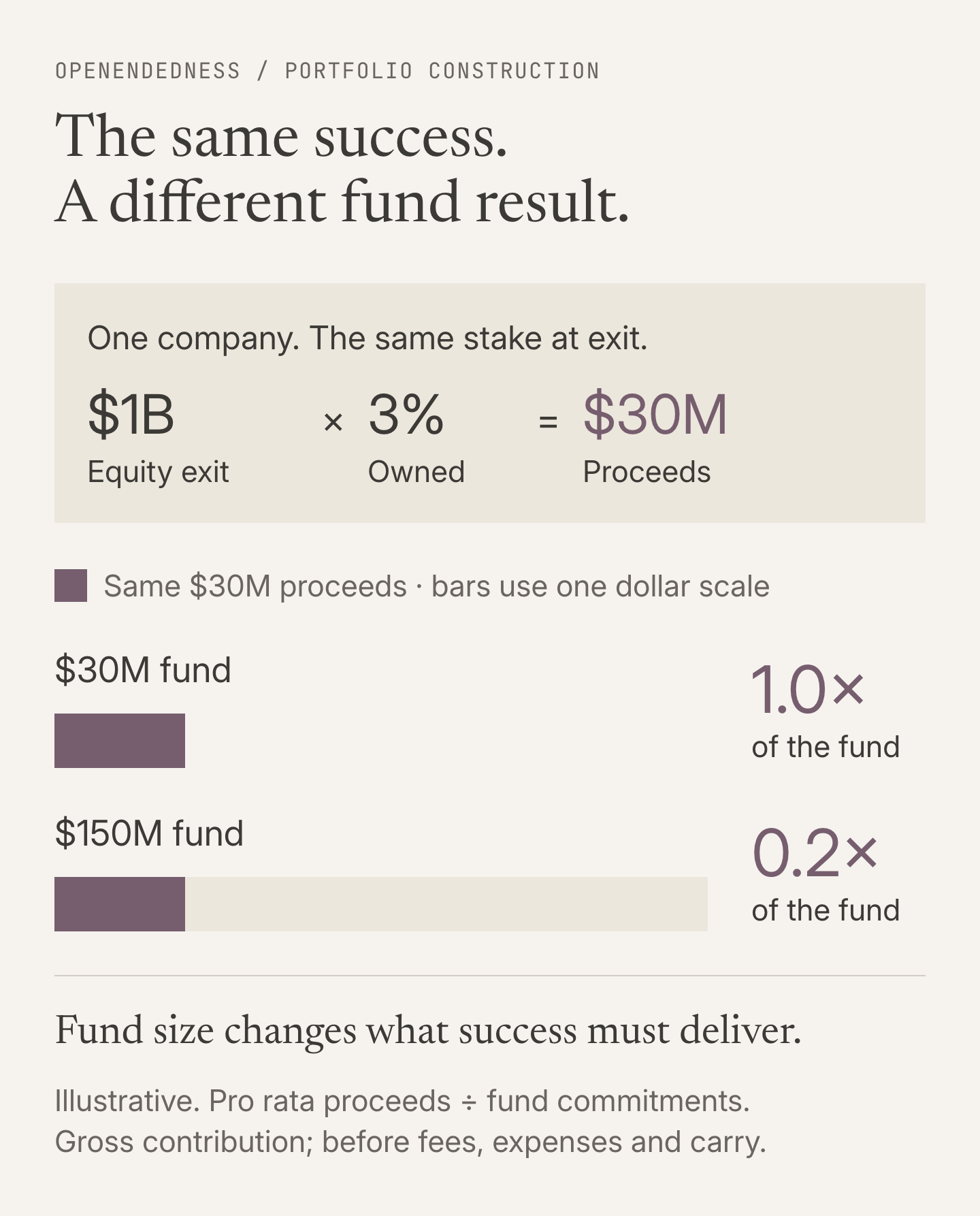
A company sells for a billion dollars. Its founders have built something consequential. An early investor who still owns 3% receives $30 million, assuming the proceeds are distributed in proportion to ownership. For a $30 million fund, that one investment has generated proceeds equal to the entire fund. For a $150 million fund, it has contributed one fifth.
The company has had the same success in both cases. How much that success matters to the investor depends on decisions about fund size, price, and ownership made long before the exit.
This is why portfolio construction interests me. It connects the companies I want to back, the work I believe I can do with their founders, and the return I need to generate for the people investing with me. Those choices need to make sense together.
My path has been operator, then founder, then investor. That progression is central to how I’m building Generalize. I believe relevant involvement, early enough, can improve a company’s prospects. I’ve constructed the fund around that belief, including the capacity to do the work and the possibility that I will sometimes be wrong.
The arithmetic is the useful place to start. If you’ve spent enough evenings arguing with a portfolio spreadsheet, feel free to skip ahead to “My bet is that involvement matters.” The spreadsheet will survive without us for a few paragraphs.
In a simplified exit where proceeds follow ownership, a company’s contribution to the fund is:
Ownership at exit × company equity value at exit ÷ fund size.
Suppose a hypothetical $30 million fund buys 5% of a company. Subsequent financing reduces that stake to 2.5%. To generate $30 million of proceeds, the company needs a $1.2 billion equity exit. If ownership falls to 1.25%, the required exit doubles to $2.4 billion.
These are gross proceeds relative to fund commitments. Fees, expenses, carried interest, and time still separate this arithmetic from an LP’s net return. Generating proceeds equal to the fund is also a much lower hurdle than producing an attractive result for its investors.
The calculation makes the consequences of price and dilution visible. For the same check, a higher entry valuation buys less ownership and raises the eventual outcome required. A smaller fund, at a given ownership level, can be meaningfully affected by a wider range of exits. Whether the investor can obtain that ownership in companies worth owning remains the harder question.
Then there is the number of investments.
Jerry Neumann’s essays on power laws explain why exceptional outcomes deserve so much attention in venture. A few investments can dominate the result. His portfolio construction essay explores the implications for diversification. The practical tension is familiar: more investments give you more opportunities to encounter an outlier, while larger positions make each winner more consequential.
Imagine, purely for illustration, that every investment has an independent 2% chance of returning at least 100 times the money invested. This is an assumption, not an estimate of venture returns. With n investments, the probability of finding at least one such outcome is 1 − (1 − 0.02)ⁿ.
With 20 investments, that probability is about 33%. With 40, it is about 55%. But if the same capital is divided equally, one investment returning exactly 100x contributes 5.0x the invested pool in the first portfolio and 2.5x in the second.
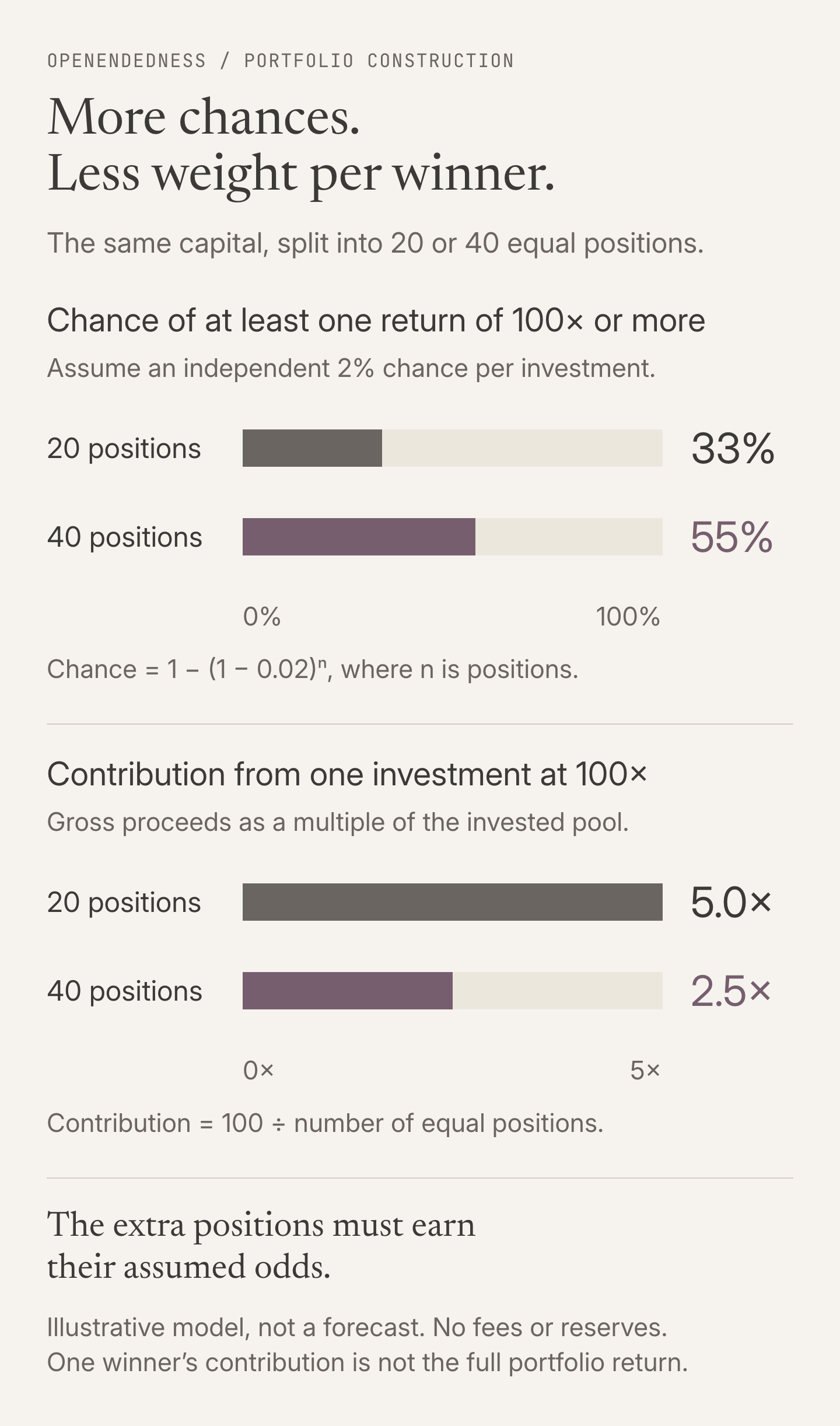
This comparison does not tell us which portfolio is better. It shows the probability of encountering a particular outcome and the contribution of one winner. To compare the chance of achieving the same overall fund return, we would need the rest of the outcome distribution too.
What it does is force a conversation. How much dependence on a few outcomes are we willing to accept? How much do we value a greater chance of participating in one, relative to owning more when we do? There is an element of taste in the risk and reward we find attractive. There are also beliefs about access, selection, and contribution that need evidence. A preference for concentration cannot establish an ability to pick or help companies.
The assumed odds deserve particular scrutiny. The additional twenty investments only retain that 2% probability if the opportunities support it. Companies can also depend on the same customers, financing conditions, or technology, making them less independent than their different names suggest. I think the quality of the marginal investment gets too little attention in conversations about diversification.
My bet is that involvement matters.
The examples above hold the probability per investment constant. My strategy makes a further claim: the work an investor does can influence the outcomes. That means portfolio size affects both how many companies I can back and what I can contribute to each one.
My experience as an operator and founder is the basis for believing I can be useful. It gives me a perspective on technical and commercial decisions, the difficulty of building a team, and the distance between advice that sounds reasonable and something a founder can act on. That background has to earn its relevance in the particular company. Having been a founder doesn’t make me right about someone else’s business.
At inception in AI infrastructure, the work I want to do includes testing an early product direction, finding people who can challenge a technical assumption, and helping a team get closer to the customer’s actual problem. The ambition is to improve the decisions that shape the company while those decisions are still being formed.
The LP relationships and the Tel Aviv–San Francisco corridor are part of the same design. I’m building around people whose experience is relevant to the thesis: people who can recognize a problem, question a proposed solution, or help a founder reach someone with direct knowledge of it. Working across the two places connects my relationships with builders, operators, and customers. Their usefulness depends on the specific introduction, question, or piece of work that follows.
The flywheel I’m building starts there. Relevant relationships help me understand problems and meet founders. Working closely with those founders should deepen both the understanding and the trust. If the work is useful, those relationships can lead to the next founder, the next informed perspective, and sometimes a future LP. What I learn should make me more useful the next time around.
Concentration gives that work room. I want enough ownership for a company’s success to matter to the fund, and enough time for my contribution to have a chance of mattering to the company. Adding investments beyond my capacity to do that could weaken the very advantage I’m asking LPs to underwrite. The same is true of raising a fund whose deployment requirements push me away from the work I’m best equipped to do.
Within that capacity, I still want distinct opportunities that leave room for selection errors. Being useful to a company does not make me able to recognize every eventual winner. The portfolio has to accommodate both the contribution I believe I can make and the limits of my foresight.
That is a meaningful condition of fit for an LP. If you fundamentally believe this kind of investor involvement does little to improve outcomes, Generalize may not be a good choice for you. You would be accepting the costs of concentration without believing in an important part of its rationale.
Believing involvement can help is only the beginning, though. I still have to demonstrate that my involvement is useful. Activity is easy to count; contribution is harder to establish. The questions I want to be held to are what changed, whether the founder found the work valuable, and whether there is a credible reason to connect my contribution to that change. I also need to recognize when stepping back is the more useful thing to do.
The founder should understand this too.
Part of my mission is to demystify venture for founders. Having moved from operating to founding to investing, I care about translating between those perspectives. There is too much room for each side to misunderstand what the other needs, what it can offer, and what its behavior means. I think real understanding is the only dependable starting point for alignment.
Fund size is a severely under-discussed part of that, in my opinion. A company can achieve something extraordinary for its founders and employees while producing a result that barely registers for one of its investors. The economics can influence which outcomes that investor finds attractive. A founder deserves to understand that before choosing a partner.
The concerns are rational. Will you push me toward an outcome I don’t want because your fund needs it? Will you resist a sensible financing because you’re worried about dilution? If you don’t follow on, should I read that as a loss of confidence, a constraint in your fund, or a judgment about the new price?
Those are fair questions to ask directly. More capital can dilute ownership while making the company substantially more valuable. A follow-on decision depends on new evidence, price, and available capital; the return available on the first check doesn’t establish the return available on the next. These distinctions should be discussed before a founder is left trying to infer them from an investor’s behavior.
Alignment is one of the reasons I constructed the fund this way. I started with the kinds of companies and founder relationships I want to pursue, and the work I believe I can contribute. Fund size, ownership, concentration, and the people around the fund have to support that choice. My fund’s return requirements cannot make a company’s opportunity larger than it is.
A smaller fund and close involvement won’t eliminate disagreement. They can make a meaningful company outcome consequential to both sides, and create the conditions for discussing the difficult choices with more understanding. That is the alignment I’m trying to build.
For an LP, the judgment is whether these parts fit together well enough to justify the risks: relevant experience, relationships that can improve the work, sufficient time per company, and ownership that makes success count. For a founder, it is whether the investor’s economics and proposed involvement fit the company they want to build.
I want those expectations understood before either of us needs to rely on them.