
Loops is a first-principles approach to reorganizing work around judgment, not maintenance.
I did not build Loops because I wanted a better to-do list.
I built it because I could feel my best hours slipping into the wrong layer of work.
What I care about most is being fully present where human judgment matters: in conversation, in meetings, in synthesis, in conviction, in deciding what deserves real attention. But too often, even in important moments, part of my mind was elsewhere — remembering an open loop, reconstructing context, deciding where a note belonged, wondering what a conversation should trigger next.
I wanted a different arrangement.
I wanted triage, follow-up, context assembly, and accountability to happen in a system around me, not inside my head. I wanted to spend less time maintaining the scaffolding of work and more time doing the parts only I can do.
That is what led me to build Loops.
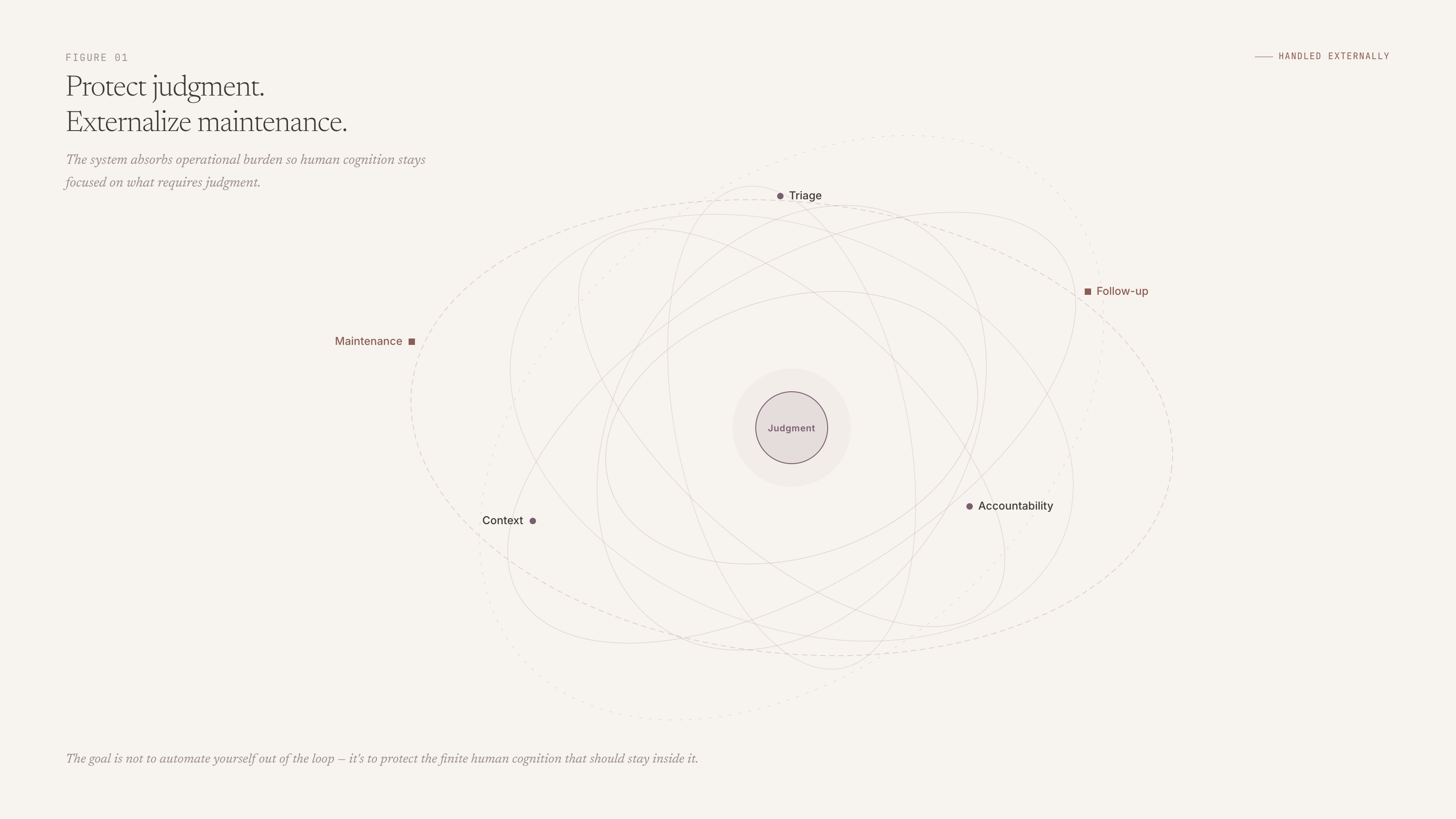
Loops is my personal operating system for high-intensity, high-creativity, high-context work. It is the structure I use to organize a life that spans building, investing, advising, writing, and training as an athlete. Soba sits inside it as the execution layer: a set of specialized agents that preserve continuity, carry context forward, and keep work moving.
The goal is not to automate myself out of the loop. The goal is to protect the finite human cognition that should stay inside it.
When the constraint changes, the system should too
One of the most useful ideas in Eliyahu Goldratt’s work is that when a major constraint changes, the right move is not to keep optimizing the old system. The right move is to redesign the system around the new reality.
That is how I think about productivity now.
Most productivity systems were built for a world in which context was expensive to carry, triage was manual, research was slow, and the person at the center had to hold a huge amount of operational state in memory. Under those constraints, it made sense to flatten work into a few containers: tasks, notes, calendar, maybe projects.
Those systems were not foolish. They were well matched to the world that produced them.
But many ambitious people still fail with them. Not because they lack discipline, and not because the software is badly made. They fail because these systems assume the user will always have the mental bandwidth to review everything, sort everything, update everything, and keep everything alive.
In practice, that maintenance burden becomes its own tax.
So the opportunity is not “AI, but for my task manager.” The opportunity is to rethink the operating system itself.
If the cost of carrying context, routing information, and maintaining continuity drops, the architecture around your attention should change with it.
The first foundational object was not a task list
The first important object in Loops was not a task list.
It was a priority register: a written record of what I care about, what I want my life to point toward, and what should shape how everything else gets interpreted.
That sounds simple. It was not.
In some ways, it was the hardest part of the system. Not because it was technically difficult, but because it was emotionally difficult. Once you write your priorities down in a way that is specific enough to matter, the system can hold up a mirror. It can show you that your calendar, meetings, research, and follow-through do not reflect the life you claim to want.
That is uncomfortable. Sometimes embarrassing.
It is much easier to say you care about something than to build a system that can ask, week after week, whether your behavior proves it.
For me, one of those priorities is becoming a leading voice on the bridge emerging between San Francisco and Tel Aviv, and embodying the kind of AI-nativeness I increasingly look for in others. Once that is written down, it stops being a vague self-image. It becomes something the system can route against. Did this week’s meetings move me toward that? Did I spend meaningful hours on it? Did my content pipeline reflect it?
That is why the priority register matters so much. It is not a motivation board. It is a commitment device.
Without that layer, the rest of the system can become clever but shallow.
Not everything in life is a task
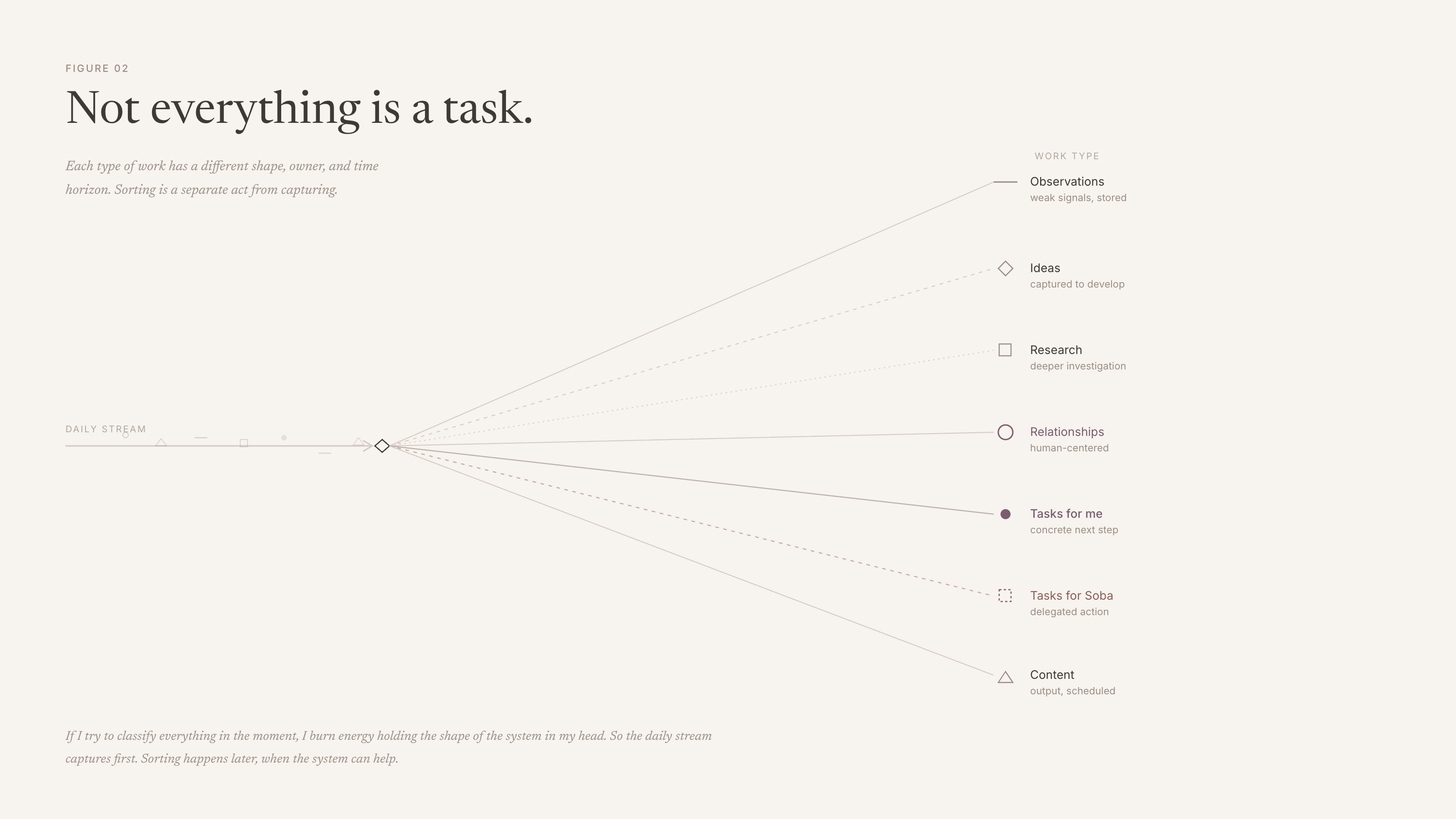
Once the priority register existed, the next thing became obvious: not everything in my life was the same kind of object.
A flat task list works for a certain class of execution. But the more strategic, creative, and relational your work becomes, the less accurate that model is. A raw observation is not a task. An idea is not a task. A research thread is not a task. A relationship is not a task.
That is what led to the loop structure: tasks for me, tasks for Soba, ideas, observations, research loops, relationship loops, and a content orbit.
The goal is not to create more buckets. The goal is to stop flattening reality.
Meaningful work has different levels of maturity, different owners, and different time horizons. Force all of that into a single queue and you lose signal. You also make it harder to see what kind of attention something actually needs.
This is why capture and triage have to be separate. If I try to classify everything in the moment, I burn energy just holding the shape of the system in my head. So the daily stream captures first. Sorting happens later, when the system can help.
A system only becomes useful when work moves
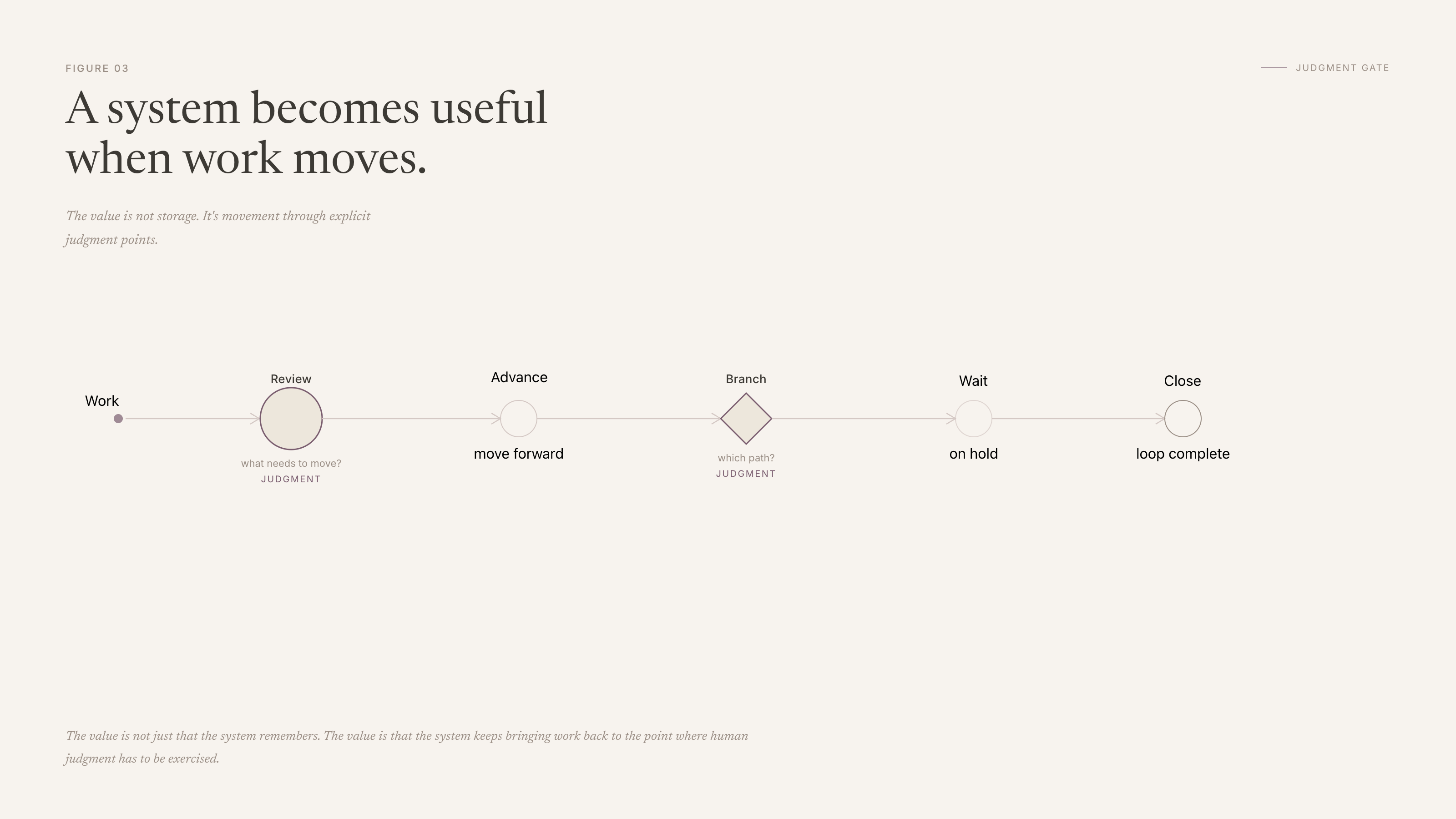
The real power of a system like this is not the taxonomy. It is the movement.
A good productivity system should not just store work. It should make it hard for important work to disappear into vagueness. It should create repeated moments that force explicit judgment: does this advance, branch, wait, or close?
Take a meeting.
In the old model, the meeting happens, notes get taken, and unless it was already important enough to remain top of mind, those notes decay into half-memory.
In my system, the meeting is only the beginning of the loop.
Soba EA may have scheduled it. I show up prepared and stay present. I take flat, high-signal notes. During daily closeout, those notes get triaged. Some fragments become observations. Others become ideas. A concrete next step becomes a task for me. A follow-up becomes a Soba task. A theme may connect to an existing research loop.
Then, during weekly review, the system forces the questions that usually stay fuzzy. Does this relationship need follow-up? Should this topic become active research? Is there another meeting worth scheduling? Or should this loop be consciously closed?
That is the part I care about most.
The value is not just that the system remembers. The value is that the system keeps bringing work back to the point where human judgment has to be exercised.
Soba is the conductor, not the decider
Loops is the operating system. Soba is the execution layer inside it.
Its job is to route work into the right loops, preserve continuity between them, assemble relevant context, and tee up the next state for review. In practice, that often means a chief-of-staff layer spawning smaller agents that gather information, resolve new inputs, and update the shared picture of what matters.
A lot of cognitive fatigue in ambitious work does not come from the hardest decisions. It comes from the background maintenance around those decisions: remembering what changed, what is blocked, what deserves follow-up, what belongs where.
That is the drag Soba is designed to absorb.
But there is a line I care about preserving. Soba can orchestrate, prepare, route, and propose. It does not decide what deserves my life.
I decide what moves from a five-minute brief into a 45-minute session. I decide which conversations deserve another hour. I decide which people I want to spend real time with. I decide whether a research thread is worth deepening, whether a content idea should become an essay, and whether a loop should close.
I own the judgment. I own the output.
What compounding looks like in practice
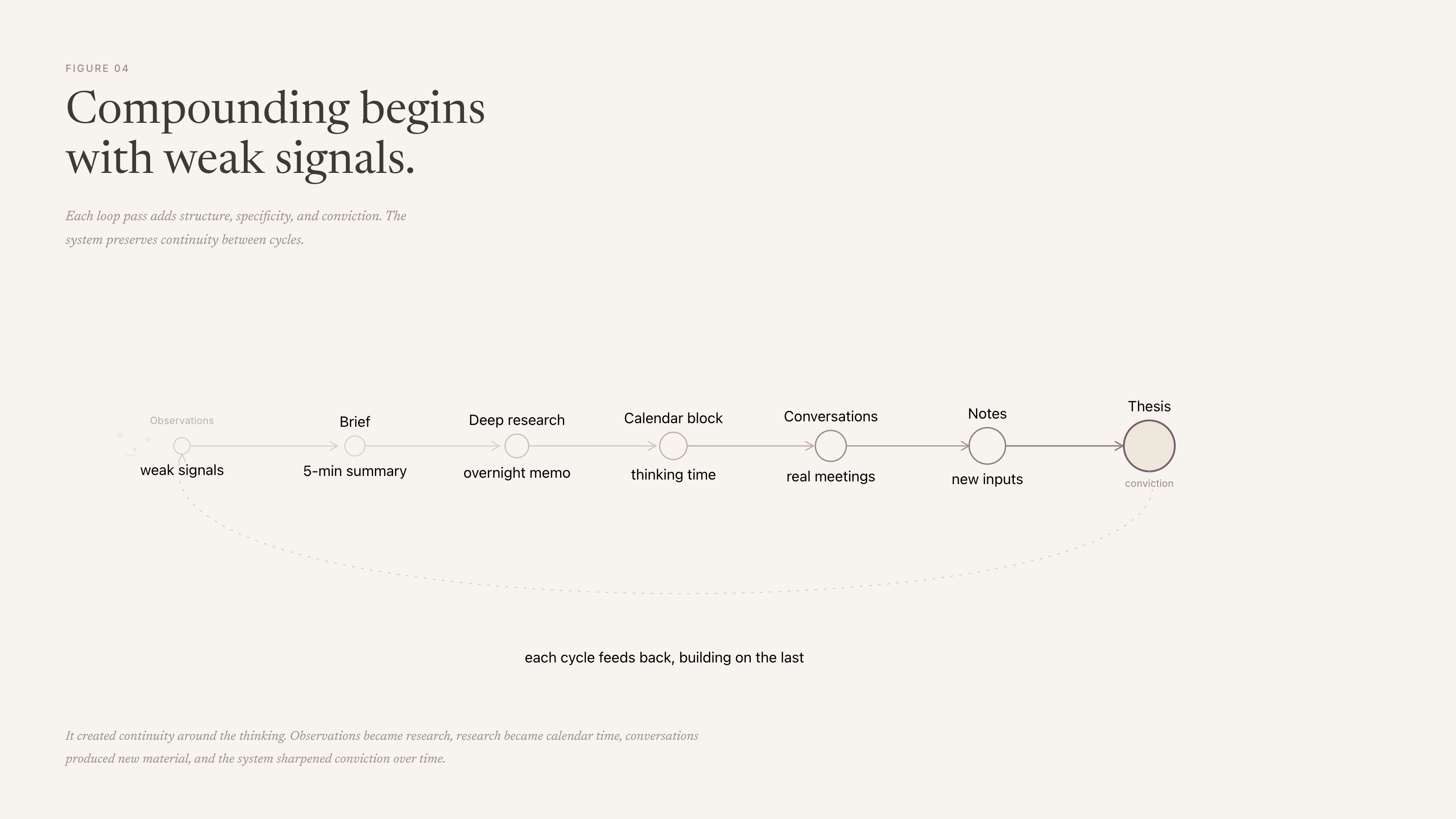
One of the clearest examples for me was a topic I started exploring around AI for science.
It did not begin as a task. It began as scattered observations: fragments from conversations, weak signals, a sense that something was there but not yet structured enough to justify a full project.
In Loops, those observations entered the research loop. Soba Research generated an initial five-minute brief overnight — enough to tell me whether the signal was real and where the obvious questions were.
That justified a deeper pass. The topic moved into a more serious research state, with a longer memo and a stronger map of the landscape.
Then the system did something important: it created the condition for judgment. Soba EA blocked 45 minutes on my calendar so I would actually engage with the topic instead of merely feeling interested in it.
During that session, I had an interactive exchange with Soba Research. We challenged sources. I asked it to expand certain areas. It helped me pressure-test the shape of my thinking in real time. Those notes created new branches: refinements of the thesis, open questions, prompts for people I should meet.
That triggered another loop. Overnight, a Soba agent identified researchers, founders, and operators I should speak with to test the idea further.
Some of those meetings happened. They produced notes, questions, stronger conviction, and sometimes transcripts. Those outputs fed back into the research loop and eventually sharpened into a thesis.
That is what I mean when I say the loops intersect. Observations became research. Research shaped the calendar. The calendar led to conversations. Those conversations produced new material. That material updated the research.
Soba did not do the thinking for me.
It created continuity around the thinking.
The broader point
This is why I think the future of productivity is not better task management.
The people I know doing the most meaningful work are rarely suffering from a lack of effort. More often, they are suffering from a mismatch between the shape of their work and the shape of the systems they use to organize it.
If your work is strategic, creative, and deeply human, much of it will begin as partial signals, conversations, questions, and commitments that evolve over time. The bottleneck is often not action. It is interpretation.
A flat productivity system is too blunt an instrument for that.
Which is slightly funny in my case, because underneath all of this system-building, the desire is simple: to be fully present in the moment and let the rest disappear.
That is why the opportunity feels architectural to me. The old systems were not wrong for their time. They were built around the constraints that existed. But once the burden of carrying context and maintaining continuity starts to weaken, the design space changes.
And once the design space changes, the question changes too.
Not how to make the task manager smarter.
What should the operating system look like now?
My answer, at least for this phase of my life, is Loops: a system organized around distinct kinds of work, where items move between loops as they mature, agents handle more of the mechanics, and finite human cognition gets spent where it matters most.